Showing posts with label Primates. Show all posts

Monday, 8 October 2018

Congratulations Hiroaki Soma

Professor Hiroaki Soma (at left) recipient of the 2018
IFPA Senior Award
It is a pleasure to record that my good friend and colleague Hiroaki Soma received the Senior Award of the International Federation of Placenta Associations at their recent meeting in Tokyo.

In his address, Professor Soma looked back over 60 years of research including important clinical work on gestational trophoblastic disease in Japan and placental lesions associated with pregnancy at high altitude in Nepal.

In addition, he gave valuable insights about comparative placentation. The range of mammals included chinchilla, giant panda. Japanese serow, sloth, chimpanzee, elephant, manatee and hyrax. As if this were not enough, Professor Soma also presented his research on pregnancy in sharks and rays conducted at the Churaumi Aquarium in Okinawa. 

Friday, 19 February 2016

Gorilla-human split - implications for the evolution of deep trophoblast invasion


Lowland gorilla (Gorilla gorilla) female and young
at the Bronx Zoo - Wikipedia Commons (CC-BY-SA 3.0)
The fossil Chororapithecus abyssinicus is the earliest known species of gorilla. A recent paper (here) dates this fossil and calculates that the split between the gorilla and human lineages occurred more than 8 million years ago (Mya). This agrees well with an estimate based on genomic data (here) putting the gorilla-human split at 7.6 to 9.7 Mya.

Placenta of Gorilla gorilla showing invasion of decidua (at left) by
trophoblasts (black stain) following the interstitial route;
villi and intervillous space  are at right
We have shown that trophoblast invasion in gorilla and chimpanzee resembles that in humans. For example there is invasion by the so called interstitial route which does not occur in monkeys or in lesser apes such as gibbons (reviewed here and previous post).

Fetus of Gorilla gorilla photographed by Louis Bolk
Courtesy of Dr. Laurens de Rooy, Museum Vrolik, Amsterdam
Gravid uteri of great apes are not easy to come by; one of the gorilla placentas we saw was collected by Louis Bolk in 1923. He described the fetus (here) and sent the placenta to J. P. Hill in London. 

We have not been able to find a gravid uterus of an orangutan. The split between orangutan and other great apes was as deep as 15-19 Mya (here). It would be interesting to know whether human-like trophoblast invasion evolved before or after that.

Tuesday, 3 November 2015

Placentation in gibbons


Agile Gibbon (Hylobates agilis) Bristol Zoo Gallery
A recent paper on a fossil ape (here) highlights the divergence of the lesser apes (gibbons and siamangs) from the great apes (orangutans, gorilla, chimpanzee, bonobo, human). The fossil (Pliobates cataloniae) has a combination of primitive and derived features that make it difficult to place on the evolutionary tree (discussed here).
 
Gibbons themselves have placentation with some monkey-like features and others shared with the great apes.
 
Uterus of an agile gibbon (H. agilis) opened to show the decidua
capsularis enclosing the embryo. From Selenka 1899
The most important shared characteristic is that the fetus develops beneath a decidua capsularis (see previous post) implying that implantation is interstitial as in great apes. In Old World monkeys implantation is superficial and no decidua capsularis is found. 
 
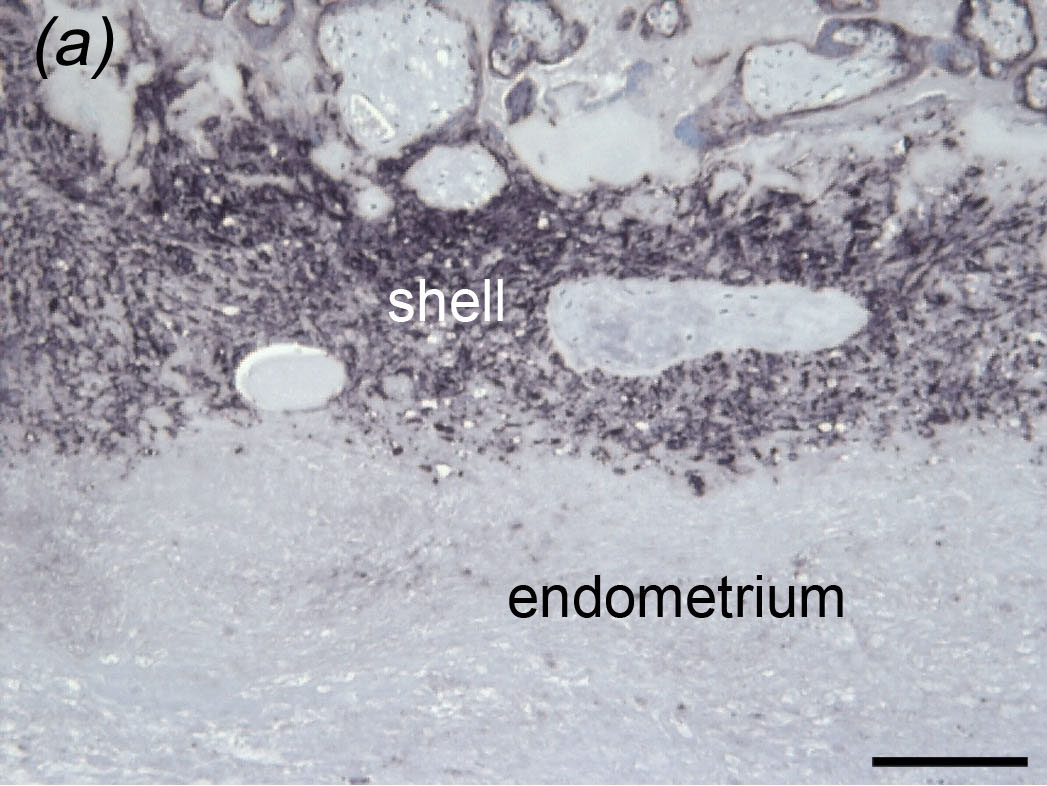
Placental bed of a Javan gibbon (Hylobates moloch)
Reproduced from Carter et al. (c) Museum for Naturkunde Berlin
However, when we examined the placenta of a Javan gibbon we found a continuous trophoblastic shell and a sharp boundary between the shell and the underlying endometrium - just as in Òld World monkeys. In great apes, the boundary is less distinct because trophoblast cells invade the endometrium by this route.

Wednesday, 17 June 2015

Human evolution: brain, birthweight and the immune system


The Royal Society recently published a special issue of Philosophical Transactions B entitled Human evolution: brain, birthweight and the immune system, edited by Graham J Burton, Ashley Moffett and Barry Keverne. The interesting theme is summarized as follows:

"The complexity of the human brain is unique amongst mammals. However, the large size of the brain at birth poses risks to mother and offspring due to constraints on pelvic architecture and uterine perfusion imposed by bipedalism, the so-called ‘obstetric dilemma’. The growth of the human brain in utero is believed to be permitted by our unique highly invasive form of placentation. The structure of the placenta varies to a greater extent between different mammalian species than any other organ. In particular, there is a spectrum of invasiveness of the fetal tissues into the wall of the uterus, even amongst the apes. Invasion poses unique immunological challenges as the migrating trophoblast cells expressing paternal genes intermingle with cells of the maternal immune system in the uterine wall that must be negotiated. Recent advances have also revealed important insights into the genetic and epigenetic links between the regulation of placental and brain growth, centred on imprinted genes that are expressed in a parent-of-origin manner. This complex network of interactions regulating brain development is explored in this Theme Issue in the light of new concepts in placental evolution, the immune system at the maternal-fetal interface, and genomic imprinting."

The table of contents can be found here. Disclosure: I co-authored one of the papers.

Wednesday, 18 February 2015

Selenka's gibbons

Bornean White-bearded Gibbon (Hylobates albibarbis)
Primate Info Net (University of Wisconsin) Photo Credit Marilyn Cole
Emil Selenka showed that the gibbon embryo, like that of humans and other apes, develops in the uterine wall beneath a decidua capsularis. But what species did he study?

Most of his figures are of a gibbon identified as Hylobates concolor (Harlan) from Borneo. The species name is still in use for Nomascus concolor, which is not found on Borneo. I now know, thanks to Dr. Thomas Geissman and his remarkable web site, that this reflects an extraordinary comedy of errors. Harlan described his ape as a hermaphrodite orangutan from Borneo; in fact it was a juvenile gibbon from Indochina!

Geographical distribution of gibbons.
(C) 2010 Thinh et al.
How then can we identify Selenka's gibbon? A study of mitochondrial genes (here) concluded that there were two species of gibbon on Borneo, one of them with three subspecies. Fortunately Selenka stated his specimens were collected on the left bank of the Kapuas River, in the territory occupied by the Bornean White-bearded Gibbon (Hylobates albibarbis) shown above.

Early stage of pregnancy in Hylobates albibarbis with amnion (A), yolk sac (D) and
exocoelom (Ex). The specimen had been flattened by contraction of the uterus but
the decidua capsularis (Dc) is clearly seen.
The embryo is depicted above. It had a primitive streak but no somites. Therefore it may correspond to Carnegie Stage 7 or early Stage 8 in the human. Selenka's paper can be found on the web (read only).

Wednesday, 21 January 2015

Emil Selenka

Emil Selenka (27 February 1842 - 21 January 1902
Emil Selenka died 113 years ago today, just before his 60th birthday. He was an eminent German zoologist, who spent much of his career studying the development of marine invertebrates, especially sea cucumbers. He turned to vertebrates rather late but made important contributions to the embryology and placentation of primates. His work on gibbons and orangutans is especially significant.

Pregnant uterus of Hylobates agilis (rafflei) showing the decidua
capsularis (d.c.) reproduced by Hill (here) from Selenka

I have shown this image before to document that gibbons resemble other great apes in having a decidua capsularis. Thus implantation is interstitial as it is in the human.

Fetus of Hylobates muelleri (Müller's Bornean Gibbon) and
uterus of Nomascus concolor (Black Crested Gibbon) from Selenka
In a moving tribute to Selenka, his pupil Hubrecht (previous post) wrote that his artistic talent was so great that it was almost a pity he became a professor of zoology rather than a painter.

Selenka amassed a large number of specimens and kept the skeletons as well as the reproductive tracts. He felt the maximum information should be gained from the animals that lost their lives. One recent study (here) estimates that Hubrecht may have bagged as many as 400 orangutans between 1892 and 1895.

Wednesday, 7 May 2014

Evolution of Neotropical primates

Geoffroy's spider monkey (Ateles geoffroyi)
Wikimedia Commons
Derek Wildman's Group at Wayne State University have re-examined the evolution of Neotropical primates (here). Using genomic data from 36 species they derive a tree with few surprises but better support than in other recent analyses.

What I found interesting is their attempt to place platyrrhine evolution in a biogeographical context. They suggest that the most recent common ancestor of extant species lived in what today is the Amazon rain forest, Guiana Shield and Northern Andes. Then, however, this was largely an area of lowlands and mountains. In support of their interpretation, known fossil sites are within this region. They further suggest that diversification of platyrrhines occurred with the establishment and development of the Amazon rain forest. 

Placenta of the white fronted capuchin (Cebus albifrons)
From Carter and Mess (here)
The founder of the Neotropical primates arrived in South America during the Oligocene when the continent was completely isolated from other land masses. Personally I favour the view (espoused here) that they came by a transatlantic route. However, Jameson Kiesling et al. suggest they may have come directly from Asia. In support they cite the occurrence of all the early fossils on the west side of the continent and recent evidence that platyrrhines may have emerged in Asia rather than Africa. In either case the means of dispersal was most likely by rafting (see previous post on sweepstakes distribution).


Thursday, 3 April 2014

Homo habilis - fiftieth anniversary

Homo habilis the handy man (Wikimedia Commons)
An article in the current issue of Nature (here) reminded me that 50 years have passed since Louis Leakey, Phillip Tobias and John Napier published their controversial paper, "A new species of the genus Homo from Olduvai Gorge" (here). Until then most fossil hominins had been accomodated in the genera Australopithecus and Pithecanthropus. Whether or not the new fossils justified the title of Leakey's paper was disputed then and remains contentious.

As I wrote at the time, "There are two criteria that might be used to define man: his ability to make tools and the size of his brain. Homo habilis scores on the first point but not on the second" (Carter AM. A new ancestor for man. The Humanist 1964; 79: 198-201).

Happy Birthday Jane Goodall
I was reading anthropology while the paper was being written and was taught by both Phillip Tobias and John Napier. I also met Louis Leakey on one of his visits to Cambridge - probably angling for a job - and was introduced to his protégée, the then unknown Jane Goodall (whose 80th birthday is today).

Friday, 31 May 2013

The origin of apes


The Rift Valley Kenya (Wikimedia Commons)

Trees based on molecular data often predict divergence points at odds with the fossil record. Thus the divergence between Old World monkeys (Cercopithecoidea) and apes (Hominoidea) has been dated to 25-30 Mya, implying a long ghost lineage for both superfamilies. New fossils from the East African Rift have now closed the gap (here). One (Nsungwepithecus gunnelli) is a cercopithecoid. The other (Rukwapithecus fleaglei) shares dental features with Miocene and extant hominoids that are not present in cercopithecoids.
Pregnant uterus of Hylobates agilis (rafflei) showing the decidua
capsularis (d.c.) reproduced by Hill (here) from Selenka

Implantation is superficial in Old World monkeys, whereas interstitial implantation occurs in all living apes including gibbons. This was shown more than a century ago by Emil Selenka. The illustration above is of Hylobates rafflei named in honour of Stamford Raffles (previous post) but now subsumed in H. agilis.

Trophoblast invasion by the interstitial route occurs neither in Old World monkeys nor in gibbons so post dates the origin of apes. This key feature of human placentation is shared by gorilla and chimpanzee (discussed here). No information is available for orang utan.

Tuesday, 2 April 2013

Mouse lemurs

Peters' mouse lemur (Microcebus myoxinus) Wikimedia Commons

Mouse lemurs are the smallest primates. Two new species have just been described bringing the total to twenty.

A previous post (here) emphasized that placentation in Malagasy lemurs is remarkably similar to that of the lorises and bush babies of Asia and Africa, i.e. diffuse in shape and epitheliochorial.

Mouse lemurs though have elaborated on this pattern. Firstly the diffuse shape is broken by a more compact disk-like portion. Secondly some areas of the placenta have become endotheliochorial through the local loss of uterine epithelium (Reng Z. Saugertierkd 1977; 42: 201.14).