Showing posts with label Gibbons. Show all posts

Tuesday, 3 November 2015

Placentation in gibbons


Agile Gibbon (Hylobates agilis) Bristol Zoo Gallery
A recent paper on a fossil ape (here) highlights the divergence of the lesser apes (gibbons and siamangs) from the great apes (orangutans, gorilla, chimpanzee, bonobo, human). The fossil (Pliobates cataloniae) has a combination of primitive and derived features that make it difficult to place on the evolutionary tree (discussed here).
 
Gibbons themselves have placentation with some monkey-like features and others shared with the great apes.
 
Uterus of an agile gibbon (H. agilis) opened to show the decidua
capsularis enclosing the embryo. From Selenka 1899
The most important shared characteristic is that the fetus develops beneath a decidua capsularis (see previous post) implying that implantation is interstitial as in great apes. In Old World monkeys implantation is superficial and no decidua capsularis is found. 
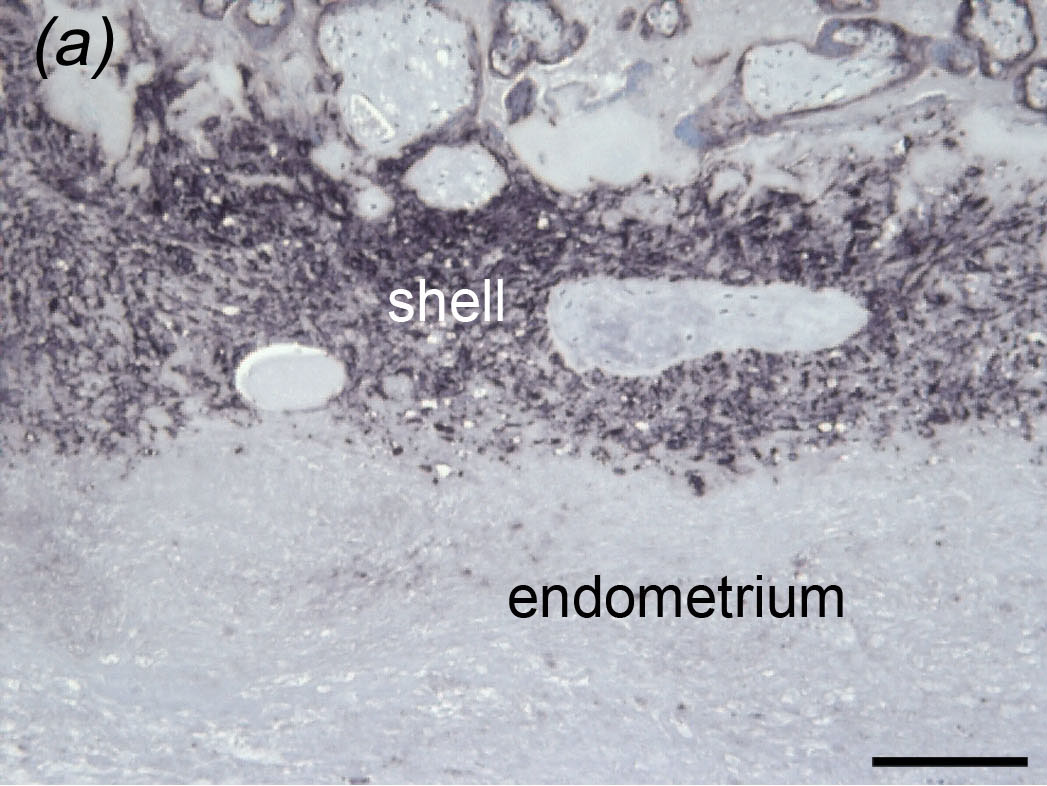
 
Placental bed of a Javan gibbon (Hylobates moloch)
Reproduced from Carter et al. (c) Museum for Naturkunde Berlin
However, when we examined the placenta of a Javan gibbon we found a continuous trophoblastic shell and a sharp boundary between the shell and the underlying endometrium - just as in Òld World monkeys. In great apes, the boundary is less distinct because trophoblast cells invade the endometrium by this route.

Wednesday, 18 February 2015

Selenka's gibbons

Bornean White-bearded Gibbon (Hylobates albibarbis)
Primate Info Net (University of Wisconsin) Photo Credit Marilyn Cole
Emil Selenka showed that the gibbon embryo, like that of humans and other apes, develops in the uterine wall beneath a decidua capsularis. But what species did he study?

Most of his figures are of a gibbon identified as Hylobates concolor (Harlan) from Borneo. The species name is still in use for Nomascus concolor, which is not found on Borneo. I now know, thanks to Dr. Thomas Geissman and his remarkable web site, that this reflects an extraordinary comedy of errors. Harlan described his ape as a hermaphrodite orangutan from Borneo; in fact it was a juvenile gibbon from Indochina!

Geographical distribution of gibbons.
(C) 2010 Thinh et al.
How then can we identify Selenka's gibbon? A study of mitochondrial genes (here) concluded that there were two species of gibbon on Borneo, one of them with three subspecies. Fortunately Selenka stated his specimens were collected on the left bank of the Kapuas River, in the territory occupied by the Bornean White-bearded Gibbon (Hylobates albibarbis) shown above.

Early stage of pregnancy in Hylobates albibarbis with amnion (A), yolk sac (D) and
exocoelom (Ex). The specimen had been flattened by contraction of the uterus but
the decidua capsularis (Dc) is clearly seen.
The embryo is depicted above. It had a primitive streak but no somites. Therefore it may correspond to Carnegie Stage 7 or early Stage 8 in the human. Selenka's paper can be found on the web (read only).

Wednesday, 21 January 2015

Emil Selenka

Emil Selenka (27 February 1842 - 21 January 1902
Emil Selenka died 113 years ago today, just before his 60th birthday. He was an eminent German zoologist, who spent much of his career studying the development of marine invertebrates, especially sea cucumbers. He turned to vertebrates rather late but made important contributions to the embryology and placentation of primates. His work on gibbons and orangutans is especially significant.

Pregnant uterus of Hylobates agilis (rafflei) showing the decidua
capsularis (d.c.) reproduced by Hill (here) from Selenka

I have shown this image before to document that gibbons resemble other great apes in having a decidua capsularis. Thus implantation is interstitial as it is in the human.

Fetus of Hylobates muelleri (Müller's Bornean Gibbon) and
uterus of Nomascus concolor (Black Crested Gibbon) from Selenka
In a moving tribute to Selenka, his pupil Hubrecht (previous post) wrote that his artistic talent was so great that it was almost a pity he became a professor of zoology rather than a painter.

Selenka amassed a large number of specimens and kept the skeletons as well as the reproductive tracts. He felt the maximum information should be gained from the animals that lost their lives. One recent study (here) estimates that Hubrecht may have bagged as many as 400 orangutans between 1892 and 1895.

Friday, 31 May 2013

The origin of apes


The Rift Valley Kenya (Wikimedia Commons)

Trees based on molecular data often predict divergence points at odds with the fossil record. Thus the divergence between Old World monkeys (Cercopithecoidea) and apes (Hominoidea) has been dated to 25-30 Mya, implying a long ghost lineage for both superfamilies. New fossils from the East African Rift have now closed the gap (here). One (Nsungwepithecus gunnelli) is a cercopithecoid. The other (Rukwapithecus fleaglei) shares dental features with Miocene and extant hominoids that are not present in cercopithecoids.
Pregnant uterus of Hylobates agilis (rafflei) showing the decidua
capsularis (d.c.) reproduced by Hill (here) from Selenka

Implantation is superficial in Old World monkeys, whereas interstitial implantation occurs in all living apes including gibbons. This was shown more than a century ago by Emil Selenka. The illustration above is of Hylobates rafflei named in honour of Stamford Raffles (previous post) but now subsumed in H. agilis.

Trophoblast invasion by the interstitial route occurs neither in Old World monkeys nor in gibbons so post dates the origin of apes. This key feature of human placentation is shared by gorilla and chimpanzee (discussed here). No information is available for orang utan.