Showing posts with label Mammalian evolution. Show all posts

Thursday, 1 July 2021

Beasts before us is a great read


Bloomsbury Sigma 2021
ISBN 978-1-4729-8397-8

Elsa Panciroli is a young Scottish palaeontologist with a story to tell. She challenges the narrative that mammals were insignificant creatures living in the shadow of the dinosaurs until after the end-Cretaceous extinction.

The first age of mammals, she tells us, was in the Permian 300-250 million years ago. This is when the ancestors of therians were dominant and included large herbivores and carnivores quite as impressive as the later dinosaurs. Then there was another extinction event triggered by massive lava flows lasting 800 thousand years - The Great Dying. Those that survived were mostly small and included the first mammaliaforms. 

Yes, the definition of a mammal, especially in the fossil record, is based on us having only two sets of teeth with the deciduous teeth being lost at weaning. So for purists Elsa Panciroli is describing the history of the Synapsids, one of the two great lineages of amniotes, from which mammals arose. The other lineage was Sauropsids that comprises dinosaurs (including birds) and reptiles.

In Pursuit of Early Mammals

The history of synapsids has been told before but in a more academic style by one of Panciroli's heroines Zofia Kielan-Jaworowska (review here). 

Some mammalian features undoubtedly evolved earlier than lactation. They include fur and differentiation of the teeth into incisors, canines and molars. The immediate ancestors of therians adopted a nocturnal life style. There is evidence for this in the structure of our eyes (two of the four types of cone in other vertebrates were lost) and most mammals have poorer colour vision than primates where it has been partially regained through evolution of opsins. 

Elsa Panciroli started this book while finishing her PhD studying Jurassic fossils from the Isle of Skye. A truly astonishing achievement. The account of synapsid evolution alternates with trips to the field, scanning of fossils embedded in rock using the synchotron near Grenoble and (carefully supervised) viewing of rare Chinese fossils. 

Zofia Kielan-Jaworowska in the field

Panciroli is also very much of her time. She laments that many key fossils were taken without consultation of indigenous people. It concerns her that most palaeontologists have been male (despite Kielan Jaworowska see here) and of course she worries intensely about climate change. In a final short chapter she speculates on what type of mammal will surive the current mass extinction.

Wednesday, 12 June 2019

Placentation in sloths

Placenta and fetal membranes of Hoffmann's Two-toed
Sloth (Choloepus hoffmanni) from Turner 1872
Two recent papers cast light on the evolution of sloths. Delsuc and colleagues obtained mitochondrial genomes from living and extinct sloths (here) while Presslee and colleagues used proteomics to describe Type I collagen - likewise from extant and extinct species (here). They agree that notions of sloth evolution based on morphology need revision. 

It was confirmed that two-toed and three-toed sloths are not closely related and group with different forms of ground sloths. A third group with a suspensory life style was found to have diverged even earlier. These sloths crossed a land bridge to the Greater Antilles and went extinct just a few thousand years ago.

Interhaemal barrier of the pale-throated three-toed sloth
(Bradypus tridactylus) Courtesy of Allen C. Enders
Together with anteaters and armadillos, sloths belong to the ancient superorder Xenarthra. Armadillo placenta has been studied in some detail. It is villous haemochorial (discussed here). Anteater placentation is rather similar (previous post). Sloths are different. As shown by Turner, the placenta is lobulated in appearance. It is labyrinthinre and endotheliochorial (here).

Given current opinion on the relations between sloths (Folivora), anteaters (Vermilingua) and armadillos (Cingulata), parsimony dictates that their common ancestor would have had a villous haemochorial placenta. Thus the sloth placenta represents a derived state. The most recent common ancestor of two-toed and three-toed sloths lived >25 million years ago whereas sloths diverged from anteaters >50 mya. 

Friday, 24 August 2018

Aye-aye captain of its own raft

An aye-aye (Daubentonia madagascariensis) foraging
Joseph Wolf c. 1863 Wikipedia Commons (public domain)
We are used to molecular data shaping our view of evolution, so it is all the more delightful when a morphological study shakes the mammalian tree.  The pleasure is no less for it involving that strange Malagasy primate the aye-aye (Daubentonia madagascariensis).

It is widely accepted that Madagascar was colonized by mammals rafting across the Mozambique Strait (see previous post). The lemurs (Lemuriformes) and the aye-aye (within its own Infraorder Chiromyiformes) have hitherto been thought to be descended from a single founder.


New tree for strepsirrhine primates from Gunnel et al. 
Nature Communications 2018 (here) CC
Now a study in Nature Communications paves the way to a new scenario. The historical background is interesting. George Gaylord Simpson (a proponent of the rafting hypothesis) once proposed a new fossil species of strepsirrhine primate Propotto leakeyi from the early Miocene of Kenya. Subsequently this was reinterpreted as a fruit bat. Now Gunnell and co-authors have unearthed the specimens from the National Museums of Kenya and compared the morphology (especially the dentition) both to the aye-aye and to Plesiopithecus teras from a late Eocene site in Egypt.

Firstly, they show Simpson was right about Propotto. Secondly, they construct a tree (combining morphological and molecular data) showing the split between Lemuriformes and Chiromyiformes occurred in the Eocene. Thirdly, it is most parsimonious to assume two separate rafting events with the ancestor of the aye-aye drifting to Madagascar on its own raft. Finally, both rafting events are likely to have occurred in the Miocene, which explains the lack of fossils of earlier date.


Placentation in the aye-aye

Allantochorion of the aye-aye. From Hill & Burne 1922 (here)
Milne-Edwards briefly described the placenta of the aye-aye (C R Acad Sci 1884), but the first complete account is by Hill and Burne (here). They described the villous nature of the allantochorion and the presence of chorionic vesicles. This contributed to Hill's later characterisation of the "lemuroid stage" of placentation where the placenta is diffuse, non-deciduate and epitheliochorial (reviewed here).

Tuesday, 3 October 2017

Tree shrews move from branch to branch

Species tree by three coalescent-based approaches
from Esselstyn et al 2017 © The Author 2017
In an heroic effort to resolve some of the difficult nodes in the mammalian tree, Esselstyn et al. used data from published genomes and added new data for a total of 100 mammals. Focussing on ultraconserved elements, they analysed all this by a battery of techniques, These included the classical maximum likelihood (ML) on concatenated data and three coalescent-based approaches. How did they do?

The first problem was to resolve the root of the eutherian tree. Here they did rather well. Both the ML tree and two of the coalescent-based methods gave strong support to the Atlantogenata hypothesis, i.e. a sister relationship between Afrotheria (elephants, dugongs, tenrecs and hyraxes) and Xenarthra (sloths and armadillos) with a common ancestor basal to Boreoeutheria (all other eutherian mammals).

South American Tapir (Tapirus terrestris)
Photo by Bernard Dupont CC BY-SA 2.0
They did almost as well with the second problem: the sister group to horses, rhinos and tapirs (Perissodactyla). In most analyses the found Cetartiodactyla (cetaceans and even-toed ungulates) as sister to Perissodactyla. However, they could not rule out one of the alternative hypotheses, which had bats (Chiroptera) as the sister group.

Whereas horses and cetartiodactyls (including ruminants, pigs, dolphins) all have epitheliochorial placentation, no bat does, so I am happy with their majority finding!
Pen-tailed tree shrew (Ptilocercus lowii)
From Wolf 1848 via Wikipedia Commons
On the third thorny problem the exercise failed. Tree shrews used to be thought the closest relatives to primates but have been toppled from this position in favour of colugos (previous post). Because some previous studies did not even include colugos, the present authors sought a remedy in including two colugos and three tree shrews, including the pen-tailed tree shrew above. The hope was that high taxon coverage would give a sounder result. But they were forced to conclude that placement remains uncertain. Tree shrews may be sister to rodents and lagomorphs (Glires) or to colugos plus primates (Primatomorpha).

Fortunately they could confirm colugos as sister to primates, which was the basis for my recent paper with Andrea Mess on the evolution from labyrinthine to villous placentation (here).


Wednesday, 25 January 2017

Prothero's Guide to Prehistoric Mammals

Princeton University Press ISBN: 9780691156828
This is an admirable effort to teach extinct mammals by showing them in  context with extant species. I found it helpful to view fossil skulls and skeletons alongside photos of familiar animals. As an additional aid, most chapters have one or more phylogenetic trees culled from the recent literature. Of course, there are extinct orders with a tenuous connection to living ones; inevitably a long chapter deals with orders that do not fit any scheme (e.g. Dinocerata).
Skeleton of Eobasileus - from the Order Dinocerata,
which is difficult to place in the mammalian tree.
Galerie de Paléontologie et d'Anatomie Comparée, Paris.
Donald R. Prothero is an experienced author and has penned a well written and informative text. The illustrations by Mary Persis Williams reconstruct the body forms of prehistoric mammals, usually with several in the same figure and with a human silhouette to give a sense of scale. These drawings are quite restrained compared to those of Velizar Simeonovski in Horned Armadillos and Extinct Madagascar (the cover is an exception).
Skeleton of the huge hedgehog Deinogalerix koenigswaldi.
National Museum of Natural History, Leiden, the Netherlands
Photo by Peter Maas (CC BY-SA 3.0) 
The book is aimed at a broad readership as "Princeton Field Guide" might suggest. The publishers have encouraged depiction of large and spectacular mammals at the expense of smaller ones. There is poor coverage of rodents. On the other hand it is the large fossils that are on display in museums of natural history.
Reconstruction of the ground sloth Eremotherium.
Exhibit in the Fernbank Museum of Natural History,
Atlanta, Georgia. Photo by Daderot (CC0)
Indeed, a field guide to fossils might be useful on museum visits. Yet though there are many excellent photos of exhibits, the museums are not identified. The two pages of Illustration Credits are of little help. The credit line to the above Eremotherium figure is merely "Daderot/Wikimedia Commons."

Figures showing phylogenetic trees suffer from a similar deficiency. One from the rodent chapter is credited to E.T. Prothero. It is redrawn from a paper on the Laotian rock rat (Laonastes) by Huchon et al. (here). The reader is ill served by not being guided to the source papers.

Tuesday, 4 October 2016

Horned armadillos and rafting monkeys

A giant caiman (Purussaurus neivensis) and small
litopterns (Megadolodus molariformis)
Illustration Velizar Simeonovski (C) 2016 by Darin A. Croft
I thoroughly recommend this new book on South American fossil mammals of the Caenozoic Era. Intended for a broad readership, it is a times fanciful. The full caption to the above figure reads, "A giant caiman (Purussaurus neivensis) finally strikes in a fury of mud and water after quietly approaching a group of small litopterns (Megadolodus molariformis) drinking at the river."

Indiana University Press ISBN 978-0-253-02084-0

The book is dedicated "to anyone who has ever wondered what a notoungulate looked like," which makes me the target audience. I read extensively about the fossil fauna when writing about the placentation of the extant species (here). The extinct families that lived side by side with marsupials and earlier xenarthrans were so unfamiliar as to seem wraith-like.

The xenungulate Carodnia vieirai from Itaboraí
Illustration Velizar Simeonovski (C) 2016 by Darin A. Croft
Darin A. Croft has worked closely with Velizar Simeonovski to bring extinct taxa to life. "The xenungulate Carodnia vieirai passes under the shadows of the dense vegetation of Itaboraí at high noon" is another example. This is the same artist who illustrated Extinct Madagascar (previous post).

After some introductory chapters the subject matter is arranged according to 15 fossiliferous localities. Conspicuously absent is Lagoa Santa in Brazil where the Danish palaeontologist P. W. Lund worked in the Nineteenth Century (here). His extensive Collection is housed at the Natural History Museum of Copenhagen University.

Thursday, 22 September 2016

Insectivores endemic to the Caribbean

Puerto Rican Nesophontes (N. edithae)
Reconstruction by Jennifer Garcia CC BY SA 3.0
The Caribbean is home to two endemic families of insectivores. The Nesophontidae are recently extinct. Their demise is attributed to the introduction of rats by Spanish Explorers though some believe the genus survived into the 20th Century.

To establish their phylogenetic position, scientists recently extracted DNA from a specimen preserved in an ancient owl pellet (here). This was no mean feat as the specimen was 750-years-old and DNA degrades rapidly in the tropics.


Hispaniolan Solenodon (S. paradoxus)
Biodiversity Heritage Library CC BY 2.0
The main finding was that Nesophontes shares a common ancestor with Solenodon. There are two species of this insectivore both listed as threatened by IUCN. A common origin had not been predicted on anatomical grounds not least because Nesophontes and Solenodon have different patterns of tooth occlusion (here). Together these families represent the oldest branch of the insectivores (Order Lipotyphla).
Placenta of Solenodon paradoxus
Wislocki (1940)
Despite its rarity, the placentation of S. paradoxus has been described (here) and we later compared it with that of other insectivores (here). Interesting features are remnants of capsular decidua, elaborately branched yolk sac villi and a sheath that superficially resembles that of crociduran shrews.

Wednesday, 24 August 2016

Mammal tree of life still not resolved

Lesser hedgehog tenrec (Echinops telfairi)
A member of the superordinal clade Afrotheria
Photo by Wilfried Berns CC BY-SA
My studies of placental evolution were stimulated by the large-scale molecular phylogenetic analyses of mammals that appeared 15 years ago (e.g. here). Especially riveting was the revelation of four superordinal clades, among them Afrotheria. 

An excellent review of the progress made in molecular phylogenetics and phylogenomics in the last 15 years recently appeared under the heading "Mammal madness" (by Foley, Springer and Teeling here). 
Competing hypotheses on the root of the mammalian tree
From Mess and Carter (here) based on Springer (Chapter here)


Some of the uncertainties arising from the earlier work remain. Most striking is the failure unequivocally to root the tree. The three competing hypotheses shown above are still in play. While consensus is tipping in favour of Model A above, retroposon analysis provides similar support for all three.

This is not all. There remains uncertainty about the branch order within Laurasiatheria, which includes bats, carnivores, pangolins and even- and odd-toed ungulates.

Such uncertainties make it difficult to plot the evolution of fetal membranes and placentation. Thus the likelihood that the common ancestor of extant eutherians had an endotheliochorial placenta is greater under Model A than the other two hypotheses (shown here).

Concatenation and coalescence

Analysis of large data sets involves some fancy statistics. Foley et al. give a fair account of the pitfalls in concatenation, used in all the early papers, and coalescence. Coalescent methods require much more computer time and are not applicable to large data sets unless short cuts are taken. So far this has not worked out too well.

An article just appeared in Cladistics (here), which seems to demand a "correction," in reality a retraction, of a paper in PNAS based on a coalescent approach. The authors doth protest too much, methinks. As Foley et al. point out, some pretty weird results appeared in the early days of DNA studies, too.

Morphology and molecules

The attitude of some researchers to morphological data could also be more generous. Attempts to integrate morphology and molecules, such as O'Leary et al. (previous post) do throw up some counterintuitive results. But there are examples where fossils have been useful in bolstering hypotheses based on molecular data - the position of whales is a case in point (previous post). Similarly, Afrotheria is not well supported by morphology, but we have published an apparent synapomorphy in the form of the allantoic sac (here).

Moreover fossil calibrations are the key to solving another conflict, which concerns the timing of ordinal diversification of mammals. Deservedly this is given close attention in Foley et al.'s excellent review. The sort of fossils we are talking about are too old to yield ancient DNA so we have only morphology to go on.

Foley et al. finish on an optimistic note and predict the next 20 years of phylogenetic research "should result in the resolution and dating of the mammal tree of life."


Monday, 15 August 2016

A colugo genome at last

Phylogenetic placement of colugos  (Scandentia) in the lineage of primates
From Mason et al. Sci Adv 2016 (here) CC BY-NC
Used to be that tree shrews (Scandentia) were regarded as the closest relatives to primates as cogently argued by Wilfrid Le Gros Clark. Molecular phylogenetics have brought that into question with some proposing colugos  or "flying lemurs" (Dermoptera) as a better alternative. But there have several competing hypotheses (see Martin). Choosing the right one has been difficult in the absence of a colugo genome.

Now that has been rectified in a comprehensive study by Mason and colleagues (here) who sequenced the genome of a Sunda colugo and compared it with genomes from 21 mammals. The result clearly came out in favour of colugos as the closest relatives to primates, supported by  20 shared indels and 16 shared retrotransposons.

There are many morphological similarities between tree shrews and colugos but the tree constructed by Mason et al. implies these are due to convergent evolution. Within Euarchontoglires they find tree shrews as the sister to Glires (rodents and lagomorphs).
Museomics and hidden biodiversity within colugos

Colugo fetus and placenta at term; ys = yolk sac;
pat = patagonium From Hubrecht 1894 (here)
Current reference works recognize no more than two species of colugo: Sunda Colugo (Galeopterus variegates) and the Phillipine Colugo (Cynocephalus volans). Mason et al. conclude that there may be as many as 6 Sundaic species and 2 Phillipine ones. They reached this conclusion by extracting DNA from museum specimens of known provenance. As an example, the Eastern and western populations on Borneo are highly divergent consistent with topographical features creating barriers to dispersal.

Currently we are re-examining the placenta and fetal membranes of colugos. We too have had to rely on museum specimens such as those collected by A.A.W. Hubrecht.

The importance of museum collections has been highlighted before in this blog. It is nice that scientists other than morphologists have discovered their value and coined the term museomics for studies of DNA from ancient specimens. Those in the current study ranged from 28 to 121 years old. The oldest specimen from the Raffles Museum of Biodiversity Research is contemporaneous with those collected by Hubrecht for his study of the fetal membranes and now housed at Museum für Naturkunde in Berlin. 

Thursday, 11 August 2016

Evolution of altriciality

Kangaroo Joey inside the pouch
Photo by Geoff Shaw, Zoology, Melbourne, Australia CC BY-SA 3.0)
Marsupials and so-called placental mammals share a common ancestor yet pursue very different reproductive strategies. This led Ingmar Werneberg and colleagues to ask what reproduction was like in the common ancestor of marsupials and placentals (here).
They sampled data from the literature and examined specimens in the Hill and Hubrecht Collections at Museum für Naturkunde in Berlin. (In published sources they found examination of photographs and drawings more reliable than verbal descriptions.) There is a huge data set in the Supporting Information.

Altricial and precocial neonates exemplified by the
mouse (above) and guinea pig
It was estimated that the last common ancestor of placental mammals had a gestation of around 4 months and a litter of 3-5 young. The newborn were altricial and had closed eyes and almost naked skin at birth. The precocial lifestyle of hoofed mammals and the guinea pig is a derived feature (previous post). The newborn of marsupials are, of course, highly altricial.

A reconstruction was attempted of the neonate of the therian ancestor. This suggested it was anatomically more like extant placentals than extant marsupials. In contrast, the preweaning period was very long compared to intrauterine gestation and thus infancy in this ancestor was more marsupial-like. The relative timing of eye opening was between that of placental and marsupial mammals. Gestation lasted 31 days in this hypothetical ancestor. It was reduced to 21 days in the marsupial lineage while increasing fourfold in the placental lineage.


Friday, 27 May 2016

Tidying up the tenrecs

Dobson's shrew tenrec (Nesogale dobsoni)
Photo (C) Peter J. Stephenson
A fresh phylogenetic analysis (here) based on sequence data from all living tenrecs and one otter shrew allows a re-evaluation of tenrec systematics.

The study confirmed the web-footed tenrec (Limnogale mergulus) is nested in the genus Microgale and should henceforth be referred to as M. mergulus.

However, the authors also suggest resurrecting the generic name Nesogale for two species hitherto placed in Microgale. These are Dobson's shrew tenrec (N. dobsoni) and Talazaci's shrew tenrec (N. talazaci). Support for this included a 4-codon deletion shared only by these two species and a separate 9-codon deletion lacking in these species but found in the remaining Microgale. They concluded that this lineage had diverged from other shrew tenrecs in the Miocene.

Placentation

Villous area of the placenta of Dobson's shrew
tenrec (Nesogale dobsoni) stained for cytokeratin (brown)
We included N. talazaci and N. dobsoni in our study of placentation in shrew tenrecs (here). As in Microgale and Oryzorictes there was both a central labyrinth and a more peripheral villous area. We did not notice any differences that would set Nesogale apart.


Friday, 19 February 2016

Gorilla-human split - implications for the evolution of deep trophoblast invasion


Lowland gorilla (Gorilla gorilla) female and young
at the Bronx Zoo - Wikipedia Commons (CC-BY-SA 3.0)
The fossil Chororapithecus abyssinicus is the earliest known species of gorilla. A recent paper (here) dates this fossil and calculates that the split between the gorilla and human lineages occurred more than 8 million years ago (Mya). This agrees well with an estimate based on genomic data (here) putting the gorilla-human split at 7.6 to 9.7 Mya.

Placenta of Gorilla gorilla showing invasion of decidua (at left) by
trophoblasts (black stain) following the interstitial route;
villi and intervillous space  are at right
We have shown that trophoblast invasion in gorilla and chimpanzee resembles that in humans. For example there is invasion by the so called interstitial route which does not occur in monkeys or in lesser apes such as gibbons (reviewed here and previous post).

Fetus of Gorilla gorilla photographed by Louis Bolk
Courtesy of Dr. Laurens de Rooy, Museum Vrolik, Amsterdam
Gravid uteri of great apes are not easy to come by; one of the gorilla placentas we saw was collected by Louis Bolk in 1923. He described the fetus (here) and sent the placenta to J. P. Hill in London. 

We have not been able to find a gravid uterus of an orangutan. The split between orangutan and other great apes was as deep as 15-19 Mya (here). It would be interesting to know whether human-like trophoblast invasion evolved before or after that.

Thursday, 21 January 2016

The trouble with tree shrews

Pen-tailed tree shrew (Ptilocercus lowii)
By Joseph Wolf (1820 – 1899) [Public domain] via Wikimedia Commons
Tree shrews show so many resemblances to primates that the eminent anthropologist Wilfred Le Gros Clark included them in the same order. Molecular phylogenetics refuted this but placed them in the same clade or superorder (Euarchontoglires) as primates, colugos, rodents and lagomorphs. There has been much discussion about whether colugos (previous post) or tree shrews are the closest relatives to primates.

Just how troublesome tree shrews have become is highlighted by a new paper on mammalian evolution by Tarver et al. (here).  

Alternative roots to the mammalian tree from Mess & Carter (here)
In addition to Euarchontoglires, there are three major clades of placental mammals. But there has been considerable disagreement about how to root the tree with three hypotheses as shown above.

Tarver et al. attempted to resolve this using a huge amount of genomic data and more sophisticated modelling techniques. They argue convincingly for the hypothesis at the top of the diagram where Afrotheria and Xenarthra are sister groups in a clade called Atlantogenata.

But once again tree shrews caused trouble. In a consensus tree based on protein-coding genes, tree shrews were basal to Glires (rodents and lagomorphs). This is in agreement with another recent study (here). But in a separate data set based on genes for microRNA tree shrews were basal to all the other orders in Euarchontoglires. So much so that the clade itself collapsed as a valid taxon. Naughty tree shrews!

Placentation in several species of tree shrew was studied by Luckett (here) and later in Tupaia glis by Kaufmann (here and here). The placenta is labyrinthine and endotheliochorial. So far nobody has looked at a placenta from the pen-tailed tree shrew (pictured above). It occupies its own family and a new paper (here) characterizes it as a living fossil that has undergone little change since the Oligocene.

Incidentally, pen-tailed tree shrews have a large intake of fermented nectar from the bertram palm (described here); see this blog for "boozing tree shrews."


Tuesday, 3 November 2015

Placentation in gibbons


Agile Gibbon (Hylobates agilis) Bristol Zoo Gallery
A recent paper on a fossil ape (here) highlights the divergence of the lesser apes (gibbons and siamangs) from the great apes (orangutans, gorilla, chimpanzee, bonobo, human). The fossil (Pliobates cataloniae) has a combination of primitive and derived features that make it difficult to place on the evolutionary tree (discussed here).
 
Gibbons themselves have placentation with some monkey-like features and others shared with the great apes.
 
Uterus of an agile gibbon (H. agilis) opened to show the decidua
capsularis enclosing the embryo. From Selenka 1899
The most important shared characteristic is that the fetus develops beneath a decidua capsularis (see previous post) implying that implantation is interstitial as in great apes. In Old World monkeys implantation is superficial and no decidua capsularis is found. 
 
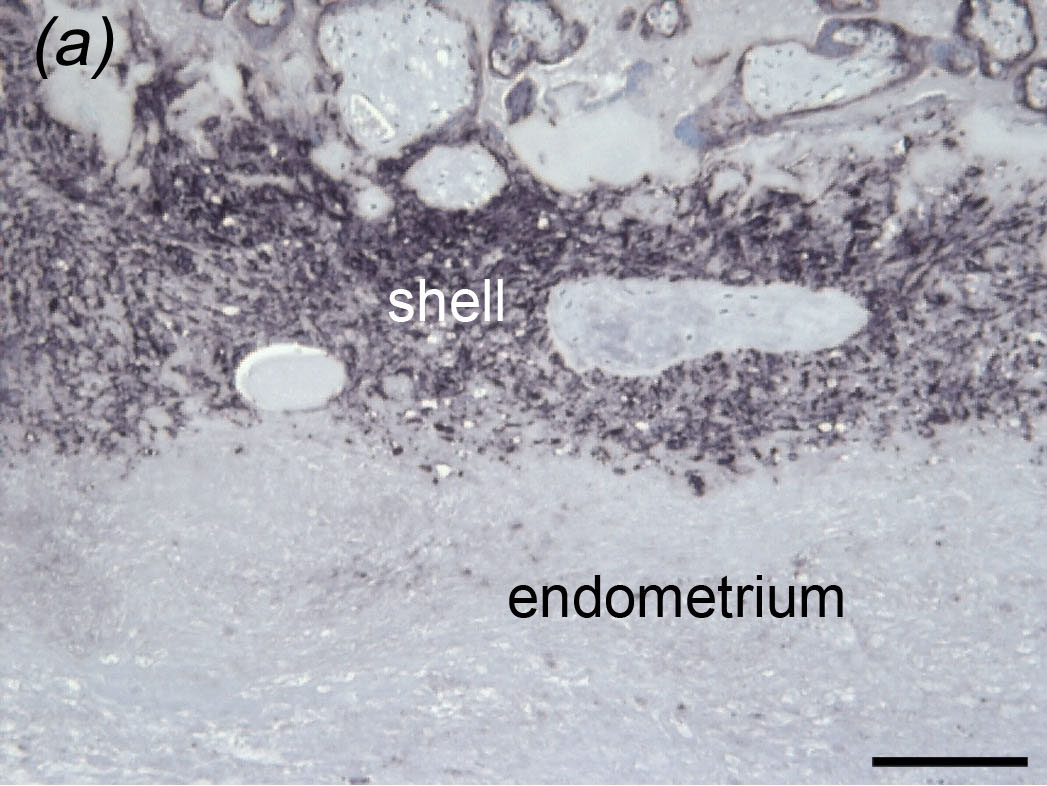
Placental bed of a Javan gibbon (Hylobates moloch)
Reproduced from Carter et al. (c) Museum for Naturkunde Berlin
However, when we examined the placenta of a Javan gibbon we found a continuous trophoblastic shell and a sharp boundary between the shell and the underlying endometrium - just as in Òld World monkeys. In great apes, the boundary is less distinct because trophoblast cells invade the endometrium by this route.

Monday, 8 June 2015

South American fossil ungulates are related to modern horses

Macrauchenia - an extinct South American native ungulate
Drawn by Kobrina Olga (Wikimedia Commons CC BY 3.0)
South American mammals either arrived recently during the Great American Interchange, came to South America by rafting (previous post), or have a shallow fossil record (xenarthrans). In contrast, South American native ungulates (SANU) have a deep fossil record. Though the lineage is now extinct, genera such as Macrauchenia (above) and Toxodon survived into the Late Quaternary. The conditions under which these fossils were conserved did not favour survival of their DNA. However, a paper just out in Nature (here) shows how proteomics can be used to probe their phylogenetic affinities.

The authors used MALDI-TOF mass spectrometry to determine the amino acid sequences of the alpha chains of type I collagen extracted from fossil bones. They then performed a phylogenetic analysis. This showed that Macrauchenia and Toxodon form a monophyletic group. Interestingly, this resolved as the sister group to modern Perissodactyla, i.e. horses, tapirs and rhinoceroses. Together they form a taxon named Panperissodactyla.

The modern species have an epitheliochorial placenta so perhaps this type was present in the sister species Macrauchenia  and Toxodon.

Thursday, 9 April 2015

Zofia Kielan-Jaworowska

Zofia Kielan-Jaworowska 1925-2015
The current issue of Nature carries an obituary of Professor Zofia Kielan-Jaworowska, the eminent palaeontologist, who died 13 March 2015.

In Pursuit of Mammals
Previously I reviewed the autobiography of this remarkable woman (here) and it remains a fascinating account of her adventurous life and the early history of mammals.

Wednesday, 25 February 2015

Did climate change do for the tragulids?

Lesser Mouse-deer (Tragulus kanchil) at Singapore Zoo
Photo by Bjørn Christian Tørrisen (CC)
In a previous post, on giraffe and okapi placenta, I mentioned that tragulids (chevrotains or mouse-deer) were the most abundant ruminants in the Early Miocene. They were displaced by the pecoran ruminants and today are represented by a mere handful of species.

A new paper in PLoS One re-examines the European fossil fauna and shows tragulids already were on the way out in the Oligocene (full text here). The focus of the study is on a narrow time period called MP28 (MP stands for Mammal Palaeogene zone). This was a period of global warming that led to wooded environments being replaced by more open habitats and the appearance of seasonality including a dry season.

Pecorans have an additional forestomach, the omasum, and this may have given them the edge over tragulids in exploiting new resources. 

Placenta of Lesser Mouse-deer showing binucleate cells stained with
anti-bovine lactogen. From the Benirschke web site.
Although tragulids have the binucleate trophoblast cells that are the signature feature of ruminant placentation, they differ from pecorans in lacking cotyledons (reviewed here).

Thursday, 5 February 2015

Evolution of the decidua

In preparation for pregnancy, the endometrium undergoes a process called decidualization (previous post). This involves a change in the size, shape and properties of the connective tissue cells (stromal fibroblasts). Decidualization is a necessary prerequisite for implantation of the blastocyst and often occurs in response to an embryonic signal. In women, decidualization happens in response to a maternal signal in the second half of the menstrual cycle.
 
Decidua was present in the most recent common ancestor of placental
mammals but was lost in some lineages. Data from A. M. Mess and A. M. Carter
Based on a phylogenetic analysis (here), Andrea Mess and I concluded that decidualization was present in the most recent common ancestor of placental mammals (extant Eutheria). It was lost in some lineages, especially in those that evolved a non-invasive epitheliochorial placenta.

Gray Four-eyed Opossum (Philander opossum)
Wikimedia Commons CC-BY-3.0 (André de Souza Pereira)
How about marsupials, all of which have a yolk sac placenta? In most placentation is non-invasive and none has been shown to have a decidua. In the Gray Four-eyed Opossum (Philander opposum), however, there is penetration of the endometrium by trophoblast and traces of a primitive decidual reaction (here). This ties in quite nicely with a recent study (here) of gene expression in the endometrium of the Gray Short-tailed Opossum. This identified a population of endometrial stromal fibroblasts that expressed progesterone receptor and some transcription factors associated with human decidual cells. On the other hand, the fibroblasts did not express the decidual marker desmin or other transcription factors required for decidualization.

The authors of the latter paper are part of a consortium that just published an extensive analysis of gene expression by the endometrium across mammals (here). The study included a frog, chicken, lizard, monotreme (Duck-billed Platypus), marsupial (Gray Short-tailed Opossum), and seven different placental mammals. It identified a huge number of genes that were recruited during the evolution of pregnancy in mammals, including many that are associated with the decidualization process.

The main thrust of the new paper is the central role played in evolution by transposable elements. These were co-opted into regulatory elements that coordinate the endometrial progesterone response.

Thursday, 29 January 2015

Marsupial placentation - now with endogenous retroviral genes

Gray Short-tailed Opossum (Monodelphis domestica)
Wikipedia CC-BY-SA-2.5 (uploaded by Dawson)
In marsupials gestation is short and the embryo is supported by a yolk sac placenta (previous post). Just a few have an additional chorioallantoic placenta; they include wombats and the koala.

Syncytins are endogenous retroviral proteins that promote fusion of trophoblast to form a syncytium. They have been identified in several orders of placental mammals including ruminants and rodents. One marsupial, the Gray Short-tailed Opossum, has syncytial trophoblast. This led Guillaume Cornelis and colleagues to ask if it also had a syncytin. Their findings just appeared in PNAS (here). In brief, they did find a syncytin, which was named syn-Opo1; it was expressed in the placenta and able to promote cell fusion. The gene was present in most but not all members of the genus Monodelphis and absent in other marsupials. Thus it represents a relatively recent capture of a retroviral envelope (env) gene.

Even more intriguing was the presence of an env gene that was expressed in the placenta but unable to promote cell fusion. This gene was present in the genome of the Tammar Wallaby (Macropus eugenii), the Tasmanian Devil (Sarcophilus harisii) and 23 other marsupials. The gene was named pan-Mar-env2. Because it has been conserved (and is under purifying selection) it likely plays an important role in placentation that as yet is undefined.